Editor-in-Chief

Prof. Dr. Paola Magnano
Kore University of Enna
Italy

Prof. Dr. Gabriela Topa
Social and organizational Psychology, Universidad Nacional de Educacion a Distancia
Spain

Editor-in-Chief
Prof. Dr. Paola Magnano
Kore University of Enna
Italy
Prof. Dr. Gabriela Topa
Social and organizational Psychology, Universidad Nacional de Educacion a Distancia
Spain
Indexing & Archiving




ISSN
ISSN: 2424-8975 (Online)
ISSN: 2424-7979 (Print)
Article Processing Charges (APCs)
US$1700
Publication Frequency
Monthly since 2024
Statement on the publication process |
|
This journal is committed to upholding the rigor, fairness, and transparency of academic publishing. All manuscripts strictly adhere to the following publication process: 1. Independent Peer Review All manuscripts submitted to this journal must undergo independent peer review. Each manuscript is reviewed by at least two experts in the relevant field through a double-blind review process. Review comments are independent and anonymous, and are not influenced by the author’s identity, institutional background, or any third party. The decision to accept a manuscript is based solely on academic quality, innovation, and research integrity, with the final judgment made by the Editor-in-Chief or Associate Editor based on the review comments. 2. Prohibition of Tied Publication This journal explicitly states that it does not accept any form of tied publication. Tied publication refers to practices that make publication contingent upon the publication of other articles, the payment of additional fees, participation in specific collaborative projects, or the fulfillment of other non-academic conditions. The eligibility for publication of each paper in this journal is determined solely by the results of the academic review and is not linked to any other form of exchange conditions. 3. Transparent Review Process This journal clearly publishes the review process and timelines for each stage on its official website and submission system, allowing authors to track the status of their manuscripts in real time. All process records (including receipt, initial review, referral for review, review comments, author revisions, and final review decisions) are fully preserved for reference. 4. Ethical Review and Conflict of Interest This journal requires all submitting authors to truthfully disclose potential conflicts of interest, including but not limited to funding sources, institutional affiliations, and personal relationships that may affect the impartiality of the research. Reviewers are also required to declare any conflicts of interest upon invitation and recuse themselves when necessary. Research involving human or animal experiments must provide proof of ethical review. 5. Quality Assurance Commitment This journal commits to ensuring that every published article undergoes rigorous academic screening and quality control, and that there are no “connections-based manuscripts,” “favor-based manuscripts,” or “exchange manuscripts” of any kind. We firmly believe that the credibility of an academic journal stems from the independent academic value of each article. |
|
| Posted: 2026-03-19 | |
Statement on Further Enhancing the Academic Quality and Transparency of the Journal |
|
The implementation of these measures aims to foster a more rigorous, transparent, and trustworthy academic publishing environment. We recognize that improving academic quality requires the collective efforts of the editorial board, authors, reviewers, and readers. We look forward to working with you to uphold the integrity of academic publishing. |
|
| Posted: 2026-03-19 | |
Announcement about Artificial Intelligence in Academic Writing issues |
|
With the rapid advancement of artificial intelligence (AI) technology, the use of AI tools, such as ChatGPT and other large language models, is becoming increasingly prevalent in research publications. Art and Science Publishing House is dedicated to continuously refining and updating its policies regarding the use of AI tools in academic writing. In alignment with COPE’s position statement on AI tools, we hereby outline the following guidelines: Authorship and Accountability AI tools cannot be listed as authors or co-authors of a manuscript. This is because AI tools cannot take responsibility for the content of a submission, nor do they possess the ability to manage copyright and licensing agreements. Transparency in Disclosure Authors who use AI tools in the preparation of their manuscripts—whether for writing, data collection, or data analysis—must transparently disclose the use of such tools. This disclosure should include: A description of how the AI tool was used. The specific AI tool(s) employed. This information should be clearly stated in either the "Methods" or "Acknowledgments" section of the manuscript. Author Responsibility Authors bear full responsibility for the content of their manuscripts, including any portions generated by AI tools or data analyzed using AI during the research process. This ensures the integrity and accuracy of the published work. Consequences of Non-Disclosure Failure to disclose the use of AI tools in a manuscript will result in serious consequences. “Environment and Social Psychology” and Art and Science reserve the right to reject or retract any submission found to have concealed the use of AI tools. These guidelines are designed to uphold the highest standards of academic integrity and transparency while embracing the potential benefits of AI in research. We encourage authors to use AI tools responsibly and to provide clear and honest reporting of their use. For further clarification or questions regarding these policies, please contact our editorial office. |
|
| Posted: 2025-01-20 | |
Call for papers |
|
The Environment and Social Psychology (ESP) invites submissions of original research manuscripts in all areas of Environment psychology, including Human-Environment Interactions, Sustainability and Pro-Environmental Behavior, Climate Change Psychology, Restorative Environments, Urban Planning and Design, Place Attachment and Identity, Environmental Stressors and communication. Since 2022, ESP has been indexed in SCOPUS, further enhancing its visibility and academic impact. We encourage researchers interested in publishing with ESP to submit their work for consideration. We look forward to your valuable contributions to the journal. |
|
| Posted: 2024-12-23 | |
Announcement of New Editor-in-Chief |
|
We are delighted to announce the appointment of Professor Gabriela Topa as the new Editor-in-Chief of Environment and Social Psychology (ESP), effective December 1, 2024. Professor Topa, who is currently affiliated with Universidad Nacional de Educación a Distancia (UNED) in Spain, brings a wealth of expertise in Social and Organizational Psychology to this prestigious role. Having previously served as an esteemed member of our Editorial Board, Professor Topa has demonstrated exceptional leadership and scholarly acumen. Her appointment marks an exciting new chapter for ESP as we continue to advance our mission of publishing cutting-edge research in social psychology and related disciplines. Environment and Social Psychology is a fully open-access journal committed to disseminating high-quality research across a broad spectrum of topics within the field. Under Professor Topa's guidance, we are confident that ESP will reach new heights of academic excellence and influence.
The ESP Editorial Team and Publisher |
|
| Posted: 2024-12-01 | |
Implementation of New Article Template |
|
We are pleased to announce the launch of a new and improved article template for submissions. This updated template will replace the previous version. The new template has been designed to streamline the structure of articles, ensuring greater clarity and consistency across submissions. This will improve readability and facilitate a more efficient review process. The updated template reflects current best practices in academic publishing, It will promote transparency and reproducibility, including standardized formatting for references, figures, and tables, dedicated sections for data availability statements, ethical compliance, and conflict of interest declarations which will help authors meet international publishing standards. Action Required: Authors preparing new submissions should download the latest template from https://esp.as-pub.com/public/site/ESP-template.docx and ensure the manuscripts comply with the updated format. Reviewers and editors are encouraged to familiarize themselves with the new structure to facilitate a smooth evaluation process. Thank you for your continued support as we implement these improvements. Please follow the journal's author guideline and the required article template to prepare your manuscript. For any questions or assistance, please contact our editorial office at 21 Woodlands Close #02-10 Primz Bizhub Singapore 737854 Phone: +65 81021655 Email: editorial_office@as-pub.com |
|
| Posted: 2024-08-30 | |
Announcement: Publication frequency becomes quarterly since 2023 Volume 8 Issue 2! |
|
 |
|
| Posted: 2023-09-06 | |
New version of author guideline format |
|
| Please follow the journal's author guideline and the required article template to prepare your manuscript. | |
| Posted: 2023-08-24 | |
Announcement of new Editor-in-Chief |
|
It gives us great pleasure to announce that Professor Paola Magnano has graciously accepted the appointment as our Editor-in-Chief of Environment and Social Psychology. Professor Magnano is affiliated with Kore University of Enna, Italy. Her focus is social psychology, psychology of career counseling and education. Previously, Professor Magnano was an Editorial Board member for the journal. She will start her new position as Editor-in-Chief on August 1, 2023. Environment and Social Psychology is a fully open access publication dedicated to disseminating high-quality research in the fields of social psychology, covering a wide range of topics and themes relevant to the disciplines. We are confident that Professor Magnano will lead ESP forward to thrive. Please join us in welcoming Professor Magnano to her new role. The editorial team and publisher appreciate your continued support. |
|
| Posted: 2023-07-28 | |
Journal Transfer from Whioce Publishing to Asia Pacific Academy of Science |
|
Environment and Social Psychology will be transferring from Whioce Publishing Pte. Ltd. to Asia Pacific Academy of Science Pte. Ltd. We would like to assure all scholars that the workflow, regulations, and database inclusion of the journal will remain unchanged throughout this transfer. We will also expand the license, under which articles are published, to Creative Commons Attribution 4.0 International License (CC BY 4.0) by default since 2023 Vol.8 No.2. At Asia Pacific Academy of Science, we are committed to maintaining the high standards and reputation that Environment and Social Psychology has established over the years. The journal will continue to provide a platform for groundbreaking research in the fields of environment and social psychology, fostering academic dialogue and advancing knowledge in these areas. Thank you for your continued support, and we look forward to working with you in the future. |
|
| Posted: 2023-06-26 | |
APC for Environment and Social Psychology set at 1500 USD from August 2023 |
|
Starting from August 2023, the Article Processing Charge (APC) for the Environment and Social Psychology will be set at 1500 USD. Authors submitting their manuscripts to the journal can expect rigorous peer review, prompt and constructive feedback, and a seamless publication process. We believe that this APC will ensure that we can continue to maintain the journal's high standards, including rigorous editorial processes, professional copyediting, and open-access publication. Thank you for your continued support. We look forward to receiving your submissions and continuing our collaborative efforts to advance the field of environment and social psychology. |
|
| Posted: 2023-06-26 | |
Good News: Environment and Social Psychology Now Available on Scopus Database |
|
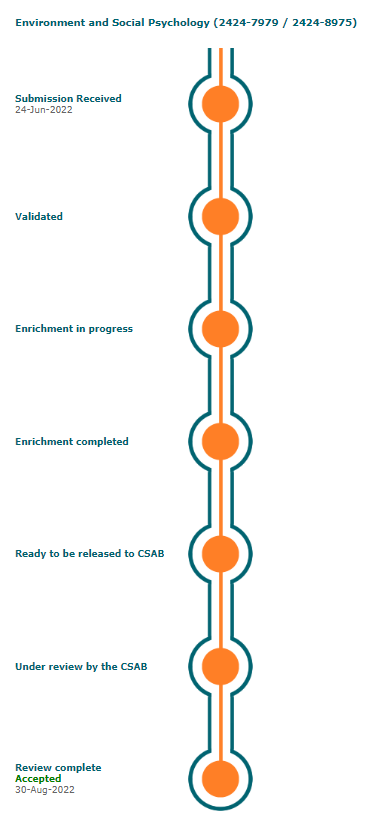
We are thrilled to announce that Environment and Social Psychology is now available on the Scopus database. We extend our heartfelt gratitude to the authors, reviewers, and editorial team for their unwavering dedication and contributions that have made this achievement possible. Together, we have created a platform that showcases the best research in environment and social psychology, empowering researchers to make a lasting impact. Thank you for your continued support, and we look forward to witnessing the far-reaching impact of Environment and Social Psychology on the global research community. |
|
| Posted: 2023-06-08 | |
Congratulations, Environment and Social Psychology has been accepted for Scopus! |
|
|
|
| Posted: 2022-09-01 | |
Showing you’re stressed may make you more likeable |
|
@Jamie Whitehouse, Research Fellow, Department of Psychology, Nottingham Trent University. We readily reveal our inner feelings during moments of weakness. When someone is stressed, they are more likely to show what we call self-directed behaviour. The more stressed a person reported being, the more stressed others thought they were – a clear linear relationship. Communicating honestly and naturally through your behaviour may in fact leave a positive impression on others. Source from: https://theconversation.com/showing-youre-stressed-may-make-you-more-likeable-new-research-182568. |
|
| Posted: 2022-05-19 | |
"The problem is greater than it’s ever been": US universities urged to invest in mental-health resources |
|
Even at a time of great financial strain and uncertainty, universities and colleges across the United States must invest more resources to address a growing mental-health crisis among students, according to a report from the US National Academies of Sciences, Engineering, and Medicine. “The problem is as great or greater than it’s ever been, and it’s not getting better,” says Alan Leshner, who chaired the committee behind the report and is chief executive emeritus of the American Association for the Advancement of Science. “Unless there’s concerted attention, it will get substantially worse, because the pressures are not going away.” The report from the National Academies carries no legal weight, and the response from colleges and universities remains to be seen. Source from: Nature 590, 171-172(2021), doi: https://doi.org/10.1038/d41586-021-00229-2 |
|
| Posted: 2021-04-04 | |
Perceiving Multiracial Individuals |
|
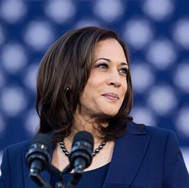 Senator Kamala Harris of California, DemocraticVice Presidential NomlneeSource: Noah Harris/Getty Senator Kamala Harris of California, DemocraticVice Presidential NomlneeSource: Noah Harris/Getty |
|
| Posted: 2021-01-07 | |
Healthier Built Environments bring more well-being! |
|
Figure 1. Contemplative Landscape Model for landscape evaluation with 1–6 points scoring scale
|
|
| Posted: 2020-03-16 | |
The mental health and the role of resilience in refugees fleeing violence |
|
Mark W Lusk and Silvia Chavez-Baray uses using mixed methods to study the mental health and the role of resilience in Mexican refugees in the El Paso, Texas border region who experienced acts of violence, extortion, kidnapping, torture, arson, or other traumatic events in Mexico. They conducted extended interviews with adult participants (n=30), gathered data using: the Harvard Trauma Questionnaire and the O’Connor-Davidson Resilience Scale. Surprisingly, results did not show evidence of post- traumatic stress disorder. On the contrary, participants were highly resilient. Family, personalism, fatalism and faith mediate the effects of the experienced violence. More details, please click https://ojs.whioce.com/index.php/esp/article/view/96. |
|
| Posted: 2019-06-03 | |
Indexing & Archiving |
|
Environment and Social Psychology has been indexed by: CNKI Scholar. All articles published in ESP are immediately searchable via Google Scholar. ESP is also being continually evaluated by other academic databases for inclusion. All the archives will be preserved by Portico. Environment and Social Psychology is the member of crossref, each article will have only one identification (DOI), and iThenticate will be utilized at the editor’s discretion to verify the originality of submitted manuscripts. Environment and Social Psychology is open access, welcome to submitting the manuscripts. Any queries or questions are welcomed.
Editorial Office of Environment and Social Psychology (ESP) Email: editial_esp@whioce.com URL: https://ojs.whioce.com/index.php/esp/about/editorialPolicies#custom-11 |
|
| Posted: 2018-05-15 | |
Meet our Editorial Team |
|
Environment and Social Psychology has a professional editorial team, including 1 Editor-in-Chief,1 associate editor, 2 book review editors, and more than 100 editorial board members from many countries around the world.
The Editor-in-Chief is Prof. Zhen Lei, and he is the Director of China Center for Behavioral Economics and Finance. He is honored as "Sichuan Tianfu Financial Leader", "Sichuan Academic and Technical Leader", and "Class A Talent of 'Guanghua Talent Project' of Southwestern University of Finance and Economics". Research field: Behavioral finance; Investment science; Experimental and behavioral economics; Neuroeconomics; theory of game; etc. Social Position: Reviewers for Economic Research, World of Managing, Quarterly of Economics, World Economy, etc. Providing investment decision-making consultation and training for government, enterprises and institutions, private equity funds, families, etc. |
|
| Posted: 2017-09-13 | |
Publishing frequency of ESP is Semi-annual! |
|
The publication frequency of Environment and Social Psychology is Semi-annual. Environment and Social Psychology is a Gold Open access journal. All articles that have been accepted will be online in time without delay. We welcome the high-quality original articles significant in environment and social psychology.
Editorial Office of Environment and Social Psychology |
|
| Posted: 2017-01-18 | |
Vol.1, No. 1 is now live! |
|
We are pleased to announce that Volume 1, Issue 1 of Environment and Social Psychology has been published, and is currently available for download. Click here to access the full issue. |
|
| Posted: 2016-07-01 | |
Call for papers |
|
Article Processing Charges ESP receives the financial support of Asia Pacific Academy of Science Pte. Ltd., hence the APC is free for authors for the time being. The editorial office of ESP expresses its sincere thanks to the sponsor. Waiver Policy ESP is committed to promoting the academic development in the world without any financial barrier to knowledge sharing and learning. There has developed a waiver policy especially for authors from low-income countries. Authors who are interested in applying for a waiver could contact editorial_esp@whioce.com. ESP reserves the right to approve or reject a waiver application. |
|
| Posted: 2016-01-10 | |
|
|